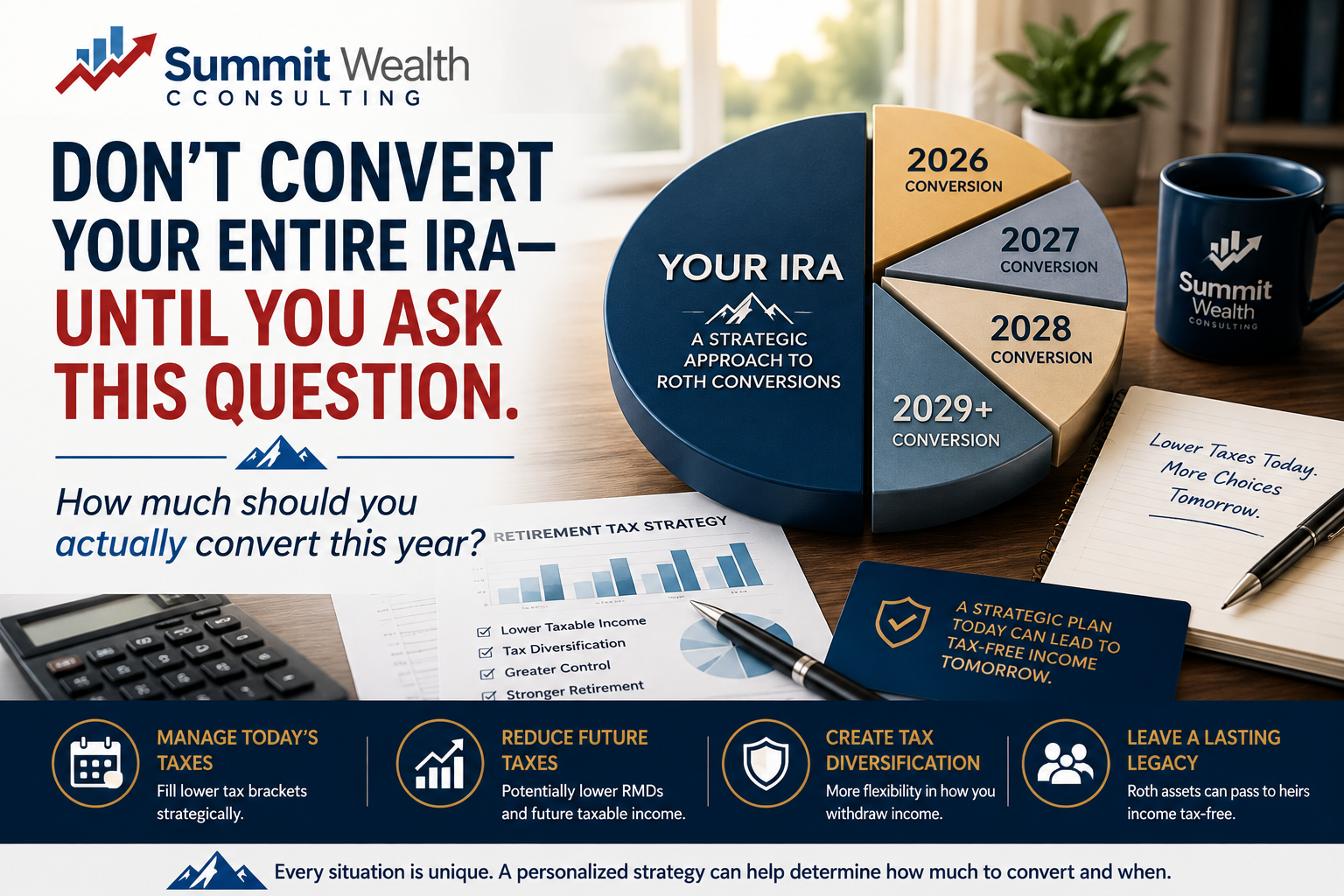
Roth conversions can be a powerful retirement planning strategy. But when it comes to Roth conversions, bigger isn’t automatically better.
The real opportunity may be determining how much to convert—and when to convert it.
Moving money from a traditional IRA or other eligible pre-tax retirement account to a Roth IRA generally creates taxable income in the year of the conversion. In exchange, qualified Roth IRA withdrawals can potentially be tax-free in retirement.
That trade-off makes tax planning essential.
The Goal Isn’t to Eliminate Taxes Today
It can be tempting to look at a large traditional IRA and think, “I should convert as much as possible.”
But a large conversion could increase taxable income substantially for that year.
Depending on your circumstances, additional income can affect your marginal tax bracket and may have implications for other parts of your financial plan.
Instead of asking, “Should I do a Roth conversion?” a better question may be:
“How much should I convert this year?”
Your Retirement Tax Window Could Matter
Some retirees experience a unique period after leaving the workforce but before other income sources become significant.
Employment income may have stopped. Social Security may not have started yet. Required Minimum Distributions (RMDs) may still be years away.
That period can create an opportunity to evaluate strategic Roth conversions.
Rather than making one enormous conversion, a multi-year strategy may allow you to gradually reposition retirement assets while managing the tax impact each year.
Think About Tomorrow’s Taxes, Too
Traditional retirement accounts generally provide tax deferral—not necessarily tax elimination.
Eventually, withdrawals from pre-tax retirement accounts are generally taxable, and RMDs can create additional taxable income later in retirement.
Roth conversions can potentially help create greater tax diversification by giving you another source of retirement income.
Having taxable, tax-deferred, and potentially tax-free accounts may provide greater flexibility when deciding where your retirement paycheck comes from.
Roth Conversions Are About Control
No one knows exactly what future tax rates will be.
That uncertainty is one reason tax diversification can be valuable.
A Roth conversion strategy isn’t necessarily about predicting future tax laws. It’s about evaluating whether paying taxes intentionally today could give you greater control over taxable income tomorrow.
At Summit Wealth Consulting, we believe Roth conversions should be evaluated as part of your complete retirement income and tax strategy—not as an isolated transaction.
The question isn’t simply whether you should convert. It’s how much, when, and why. Schedule a Consultation SWC Website Contact Us