There is an interesting contradiction happening right now.
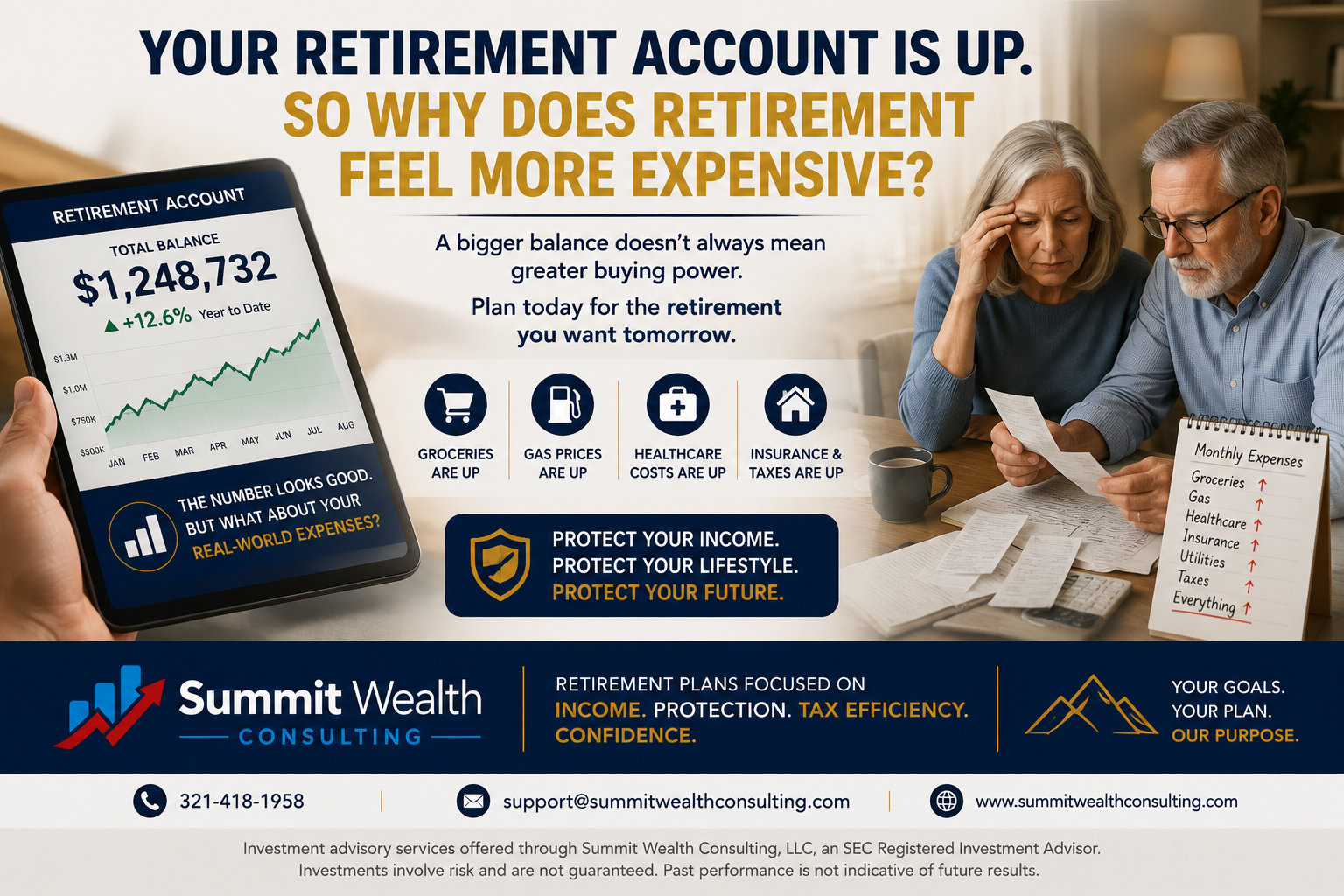
Many investors can open their retirement account and see numbers that look pretty good. The S&P 500 was still up nearly 13% for the year through August 21, despite pulling back last week.
Yet when people go to the grocery store, fill their gas tank, look at insurance premiums, or think about what their future monthly expenses may be, retirement can feel more expensive—not less.
That brings up an important question:
Is a larger retirement account the same thing as being more prepared for retirement?
Not necessarily.
The Number on Your Statement Is Only Part of the Story
I often tell people that retirement planning changes when you stop asking:
“How much money have I accumulated?”
and start asking:
“How much dependable income can this money create?”
Those are two very different questions.
A $1 million retirement portfolio sounds substantial. But that money may eventually need to help pay for 20, 25, or even 30 years of housing, food, healthcare, travel, taxes, insurance, and everyday living expenses.
And those expenses don’t stand still.
Inflation remains an important issue in 2026. The Federal Reserve reported PCE inflation at 3.7% for June, still well above its long-term 2% target.
Even relatively modest inflation can have a major effect over a long retirement.
Retirement Has Its Own Inflation Rate
This is something I think retirees should pay particular attention to.
Your personal cost of living may be very different from the inflation number you hear reported on television.
Someone in retirement may spend a larger percentage of income on:
- Healthcare
- Homeowners insurance
- Property taxes
- Utilities
- Food
- Travel
- Transportation
If those expenses rise faster than expected, the income your retirement plan produces needs to keep up.
That is why I believe retirement planning should focus on purchasing power, not simply account balances.
Higher Interest Rates Create Opportunities—and Decisions
Today’s interest-rate environment has also changed the retirement conversation.
The federal funds target range currently sits at 3.50%–3.75%, while the 30-year Treasury yield recently reached 5.34%.
For retirees and people approaching retirement, higher rates can create opportunities in certain income-oriented strategies.
But that doesn’t mean every higher-yielding option is automatically appropriate.
You still need to consider liquidity, taxes, time horizon, market exposure, income guarantees, and how each piece fits into the overall retirement plan.
I Would Rather Build a Retirement Paycheck Than Chase a Retirement Number
This is where retirement income planning becomes so important.
Instead of treating every retirement dollar the same, I prefer to look at what each dollar needs to accomplish.
Some assets may be positioned for growth.
Some may provide liquidity.
Some may be designed to create predictable income.
Some may help address future tax exposure.
And some may be positioned for legacy or long-term protection.
The goal isn’t necessarily to find one investment that does everything.
It’s to coordinate several strategies so they work together.
What Happens When Markets Have a Bad Year?
This is one of the questions people sometimes overlook during strong markets.
Accumulating money while you’re working and withdrawing money after you’ve retired are very different.
When you’re still working, a market decline can be uncomfortable.
When you’re retired and withdrawing money from the portfolio at the same time, it can potentially have a much larger impact.
That’s why I believe a retirement plan should answer an important question before retirement begins:
Where will my income come from if the market is down?
Having that answer can help reduce the pressure to make emotional financial decisions when markets become volatile.
Your Retirement Strategy Should Work in More Than One Economy
Nobody knows exactly where inflation, interest rates, oil prices, or the stock market will be five years from now.
This week alone, investors are watching inflation data and Federal Reserve policy signals while markets digest shifting economic conditions.
I don’t believe a retirement plan should depend on correctly predicting all of those things.
Instead, I believe it should be designed to function through several possible environments.
Growing markets.
Falling markets.
Higher inflation.
Lower interest rates.
Unexpected expenses.
Because retirement isn’t a one-year financial event.
It may be one of the longest financial journeys of your life.
The Question I Would Ask Today
Don’t just look at your retirement account and ask:
“How much do I have?”
Ask:
“What will this money actually do for me?”
Will it create the income you need?
Will that income keep pace with your lifestyle?
What happens if inflation remains elevated?
What happens when one spouse passes away?
What happens during a prolonged market decline?
And how much of your retirement income could ultimately be lost to taxes?
Those questions tell me far more about someone’s retirement readiness than the balance shown on a statement.
At Summit Wealth Consulting, we help individuals and families look beyond the retirement number and develop strategies focused on income, protection, tax efficiency, and long-term financial confidence.
Because the goal isn’t simply to reach retirement with money.
The goal is to create a plan that helps your money support the retirement you worked so hard to reach.
Schedule a Consultation SWC Website Contact Us
This material is for educational purposes only and should not be considered individualized investment, tax, or legal advice.