You saved. You invested. You built the retirement portfolio.
Then you finally retire—and the market drops.
For someone who is 20 years away from retirement, a market decline can be uncomfortable. For someone who has just retired and is withdrawing money to pay the bills, it can be an entirely different problem.
That’s because when investment losses happen can matter almost as much as how much your investments earn over time.
Welcome to one of the most overlooked risks in retirement planning: sequence-of-returns risk.
Two Retirees. Similar Investments. Very Different Retirements.
Imagine two people retire with similar portfolios.
Both need monthly income from their investments. Both experience periods of market growth and market decline. Over the long term, their average investment returns could even be similar.
But there is one critical difference.
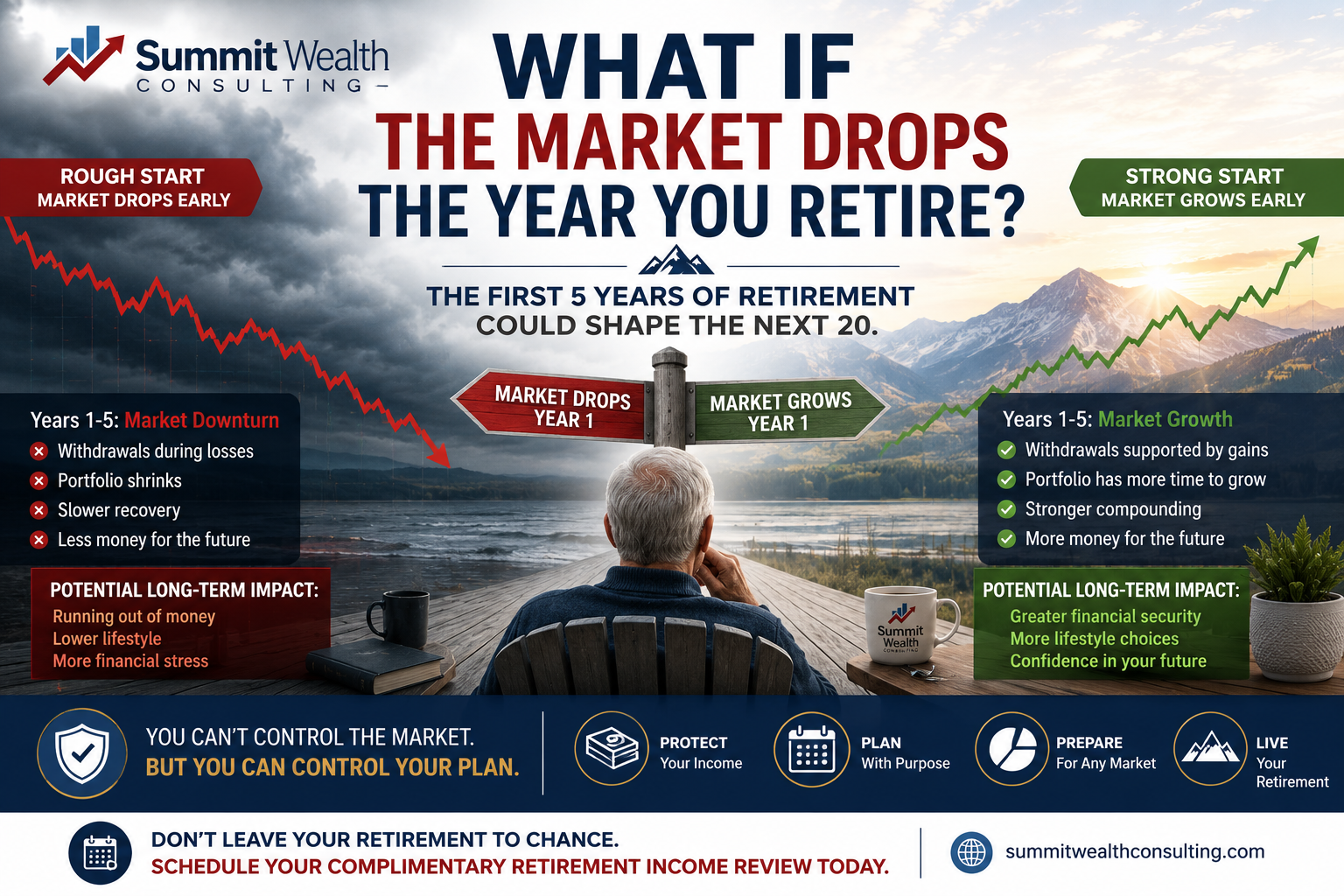
One experiences strong markets during the first several years of retirement.
The other experiences a significant downturn almost immediately.
Their outcomes can be dramatically different.
Why?
Because the second retiree may have to sell investments while they’re down just to generate the income needed for everyday expenses.
Once those shares are sold, they aren’t there to participate fully when the market eventually recovers.
That’s the danger.
Retirement Changes the Investment Equation
While you’re working, a market decline can sometimes work in your favor.
You’re still earning a paycheck. You’re still contributing to retirement accounts. And you’re potentially buying investments at lower prices.
Retirement flips that equation.
Instead of putting money into your portfolio, you’re beginning to take money out.
Now imagine withdrawing $5,000 or $7,000 every month while your portfolio is simultaneously declining.
You’re no longer simply waiting for the market to recover.
You’re asking a shrinking portfolio to produce your paycheck at the same time.
That is why the years immediately surrounding retirement can deserve special attention.
Your Portfolio Isn’t Your Retirement Plan
This distinction is important.
A collection of investments is a portfolio.
A strategy designed to turn those investments into dependable income is a retirement income plan.
They aren’t necessarily the same thing.
A comprehensive retirement strategy should consider questions such as:
- Where will your monthly income come from?
- Which accounts should you withdraw from first?
- How much liquidity should you maintain?
- What happens to your income if the market declines 20%?
- Which expenses are essential and which are discretionary?
- How will inflation affect your spending?
- When should Social Security begin?
- How will taxes affect your actual spendable income?
- Should part of your income come from sources that aren’t directly dependent on daily market performance?
Those questions become increasingly important when your portfolio stops being something you’re building and starts becoming something you’re living on.
The Retirement Paycheck Test
Here’s a simple question to consider:
If the stock market fell significantly tomorrow, where would your next 12 months of retirement income come from?
If the answer is:
“I’d just sell investments every month like I normally do,”
your retirement income strategy may deserve another look.
A well-designed plan may include different sources of money for different purposes.
Some assets may be positioned for near-term spending.
Others may be positioned for intermediate needs.
Still others may remain invested for longer-term growth.
The objective isn’t to predict the next market decline.
It’s to build a retirement strategy that doesn’t require you to predict it.
Cash Can Have a Job
During your accumulation years, holding too much cash can create its own challenges because cash may struggle to keep pace with inflation over long periods.
But retirement changes the purpose of certain assets.
A carefully considered liquidity reserve can potentially provide something extremely valuable during a market decline:
time.
Time for investments to recover.
Time to avoid making emotional decisions.
And potentially, time to avoid selling certain investments simply because this month’s bills are due.
The appropriate amount varies considerably from person to person, which is why retirement income planning should be individualized.
Don’t Forget the Inflation Problem
Avoiding market losses isn’t the only objective.
Retirement can last 20, 25, 30 years—or longer.
That means your income may also need the ability to grow.
An income strategy that’s extremely conservative might feel comfortable today but struggle to maintain purchasing power decades from now.
So retirees face a balancing act:
Protect enough money for today while keeping enough growth potential for tomorrow.
That’s why retirement planning cannot simply be about avoiding risk.
It’s about deciding which risks you’re willing to take—and which risks you cannot afford to take.
Retirement Shouldn’t Depend on Perfect Markets
Nobody knows exactly what the market will do next year.
And you shouldn’t need to.
At Summit Wealth Consulting, we believe retirement planning should be built around your lifestyle, income needs, taxes, Social Security strategy, investments, and long-term goals—not around predicting the next market move.
You’ve spent decades building your retirement savings.
Now the question changes.
It’s no longer simply:
“How much can my portfolio grow?”
The more important question becomes:
“How do I turn what I’ve accumulated into an income strategy designed to support the life I want—regardless of what the market does next?”
Are Your First Five Years Ready?
If you’re approaching retirement or have recently retired, this may be one of the most important periods of your financial life.
Don’t wait for the next market decline to discover whether your retirement income strategy works.
Schedule a retirement income review with Summit Wealth Consulting and find out whether your retirement paycheck is prepared for both good markets—and bad ones. Schedule a Consultation SWC Website Contact Us
This material is provided for educational purposes only and should not be considered individualized investment, tax, or legal advice. Investing involves risk, including possible loss of principal. Consult the appropriate financial, tax, and legal professionals regarding your individual circumstances.